iza! Global
Social Online Travel Agency
A destination-first discovery and booking platform for small-town tourism corridors. Conceived, designed, and built from zero.
- Company
- iza! Global
- Industry
- Travel & Tourism Technology
- Year
- 2024–2025
- Duration
- Ongoing (MVP in 4 months)
- Service
- Build & Launch
The Challenge
Small-town tourism corridors like South Africa's Garden Route generate meaningful economic activity, but lack a unified discovery layer. Events sit in scattered Facebook groups, dining specials get buried in social feeds, accommodation is fragmented across global platforms charging 15–30% commissions, and tourists miss experiences because there's no single source of truth for 'what's happening today.'
The founding insight was simple: every local and tourist asks the same question ('What's on today?'), but no platform existed to answer it in real time, by location, across all categories. The opportunity wasn't to compete with global OTAs at national scale. It was to dominate one corridor first, one town at a time, and build a platform where value stays local.
My Role
I served as Product Manager and Lead Engineer. I owned both the strategic vision and the technical execution. Specifically, I:
- ▸Defined the full product architecture across a 14-module ecosystem, prioritising which modules to build first based on the density-before-scale thesis
- ▸Designed the complete user experience, from radius-based discovery to vendor onboarding flows
- ▸Made all key technology decisions: Next.js with App Router for the frontend, Neon Serverless PostgreSQL with PostGIS for geolocation-aware data, NextAuth for authentication, Mapbox for mapping, and Vercel for edge deployment
- ▸Built the production codebase end-to-end using modern tooling (TypeScript, Tailwind CSS, ShadCN UI, Framer Motion)
- ▸Set up the CI/CD pipeline with GitHub Actions for automated testing and deployment
- ▸Advised on strategic business direction, revenue model design, and corridor-first expansion
This wasn't a redesign or an optimisation. This was zero to shipped product, from business model through to production deployment.
This fits under my Build & Launch offering. That's the full scope of what I do in this space.
The Approach
The build followed a deliberate sequencing philosophy: density precedes scale, and liquidity precedes expansion. Rather than building all 14 planned modules at once, I focused on the two that would create daily usage habits:
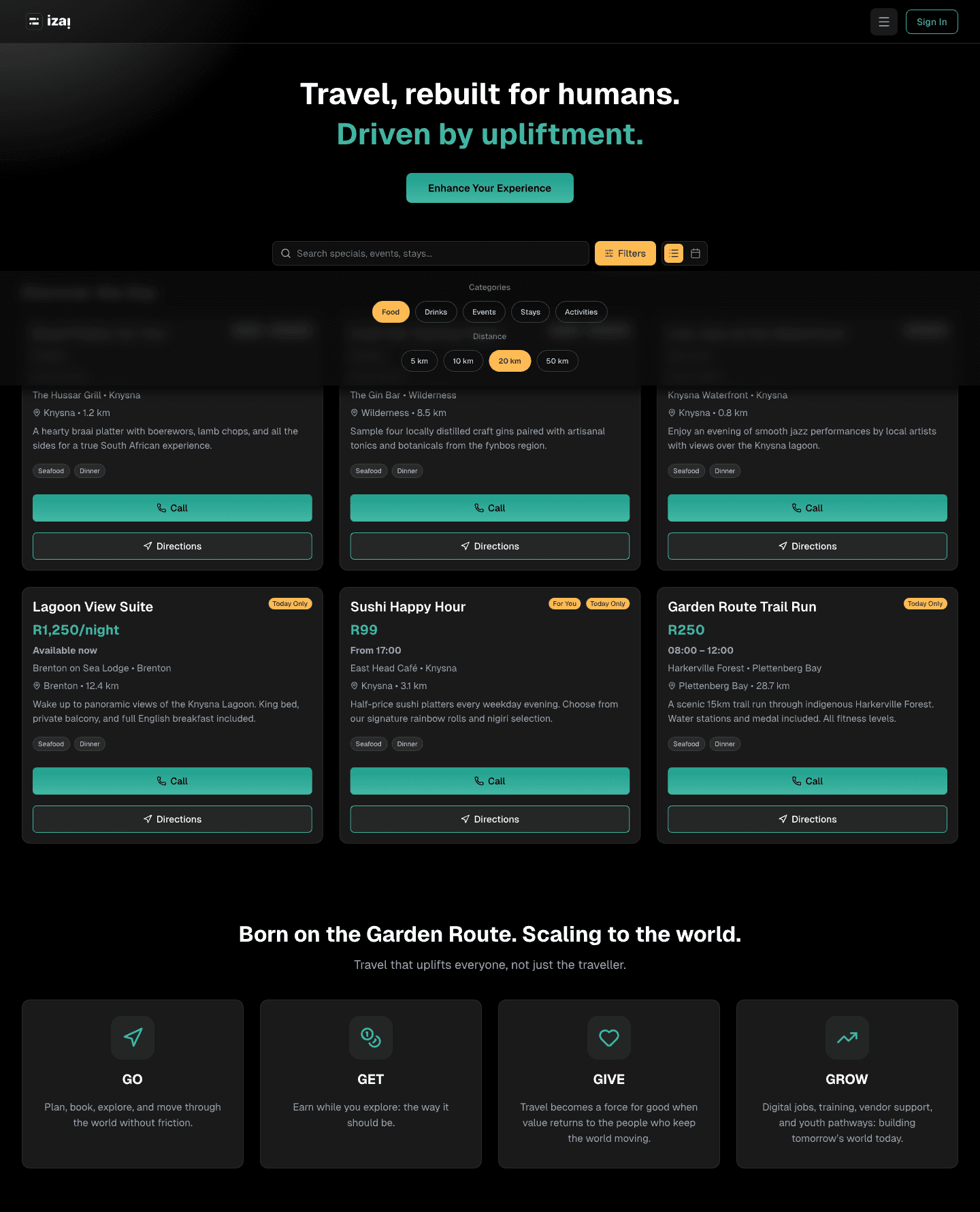
Module 1: iza! Calendar. The real-time 'what's on today' discovery engine. This is the behavioural wedge: a free, hyperlocal listings feed filtered by radius (5/10/25/50km), time relevance, and category. It answers the daily question that drives repeat visits.
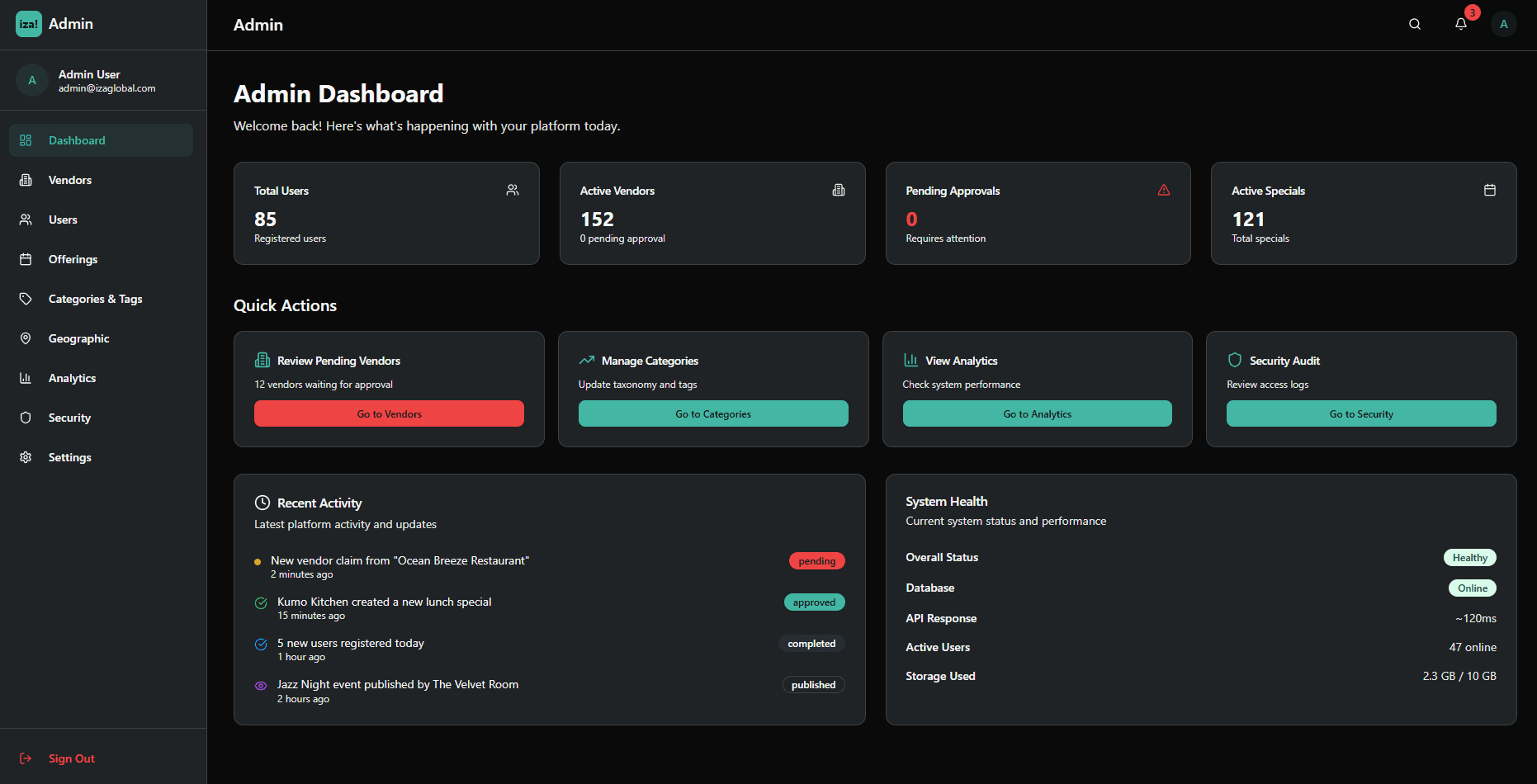
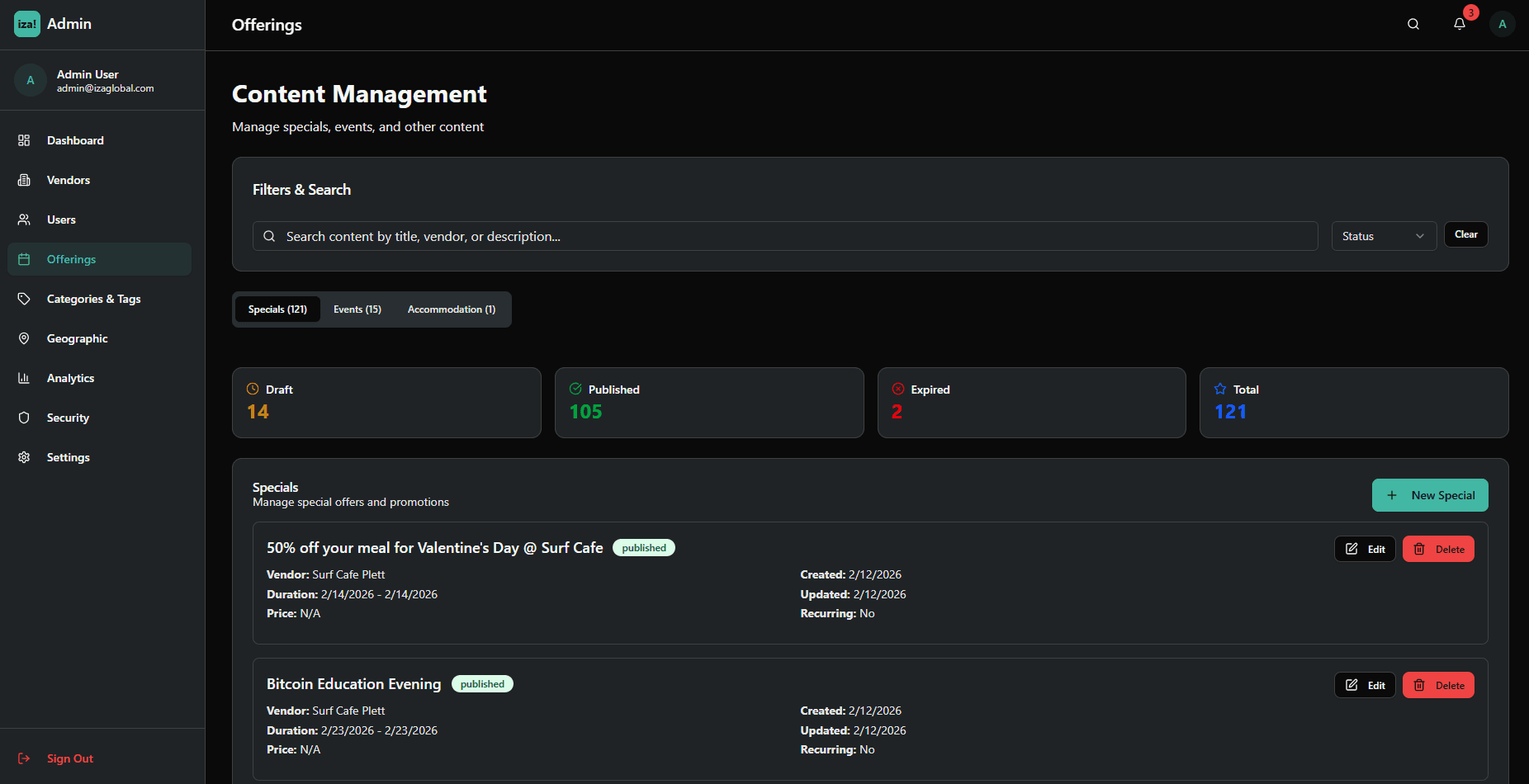
Module 2: iza! Pages. Vendor identity and trust infrastructure. Standardised profiles so businesses have a consistent, discoverable presence without depending on social algorithms.
The technical architecture was designed for a bootstrapped startup: serverless-first to keep costs down (the entire DevOps bill runs at about R1,500/month), edge-deployed for performance during seasonal spikes, and built with a stack a small team can maintain and extend.
Key decisions: PostGIS for native geospatial queries (essential for radius-based discovery), ISR (Incremental Static Regeneration) for vendor pages to balance SEO with freshness, and a database schema that supports the full 14-module roadmap from day one, even though only two modules were built initially.
The Outcome
The platform launched in Plettenberg Bay (Bitou municipality) on the Garden Route as a controlled proof-of-concept:
- ▸140+ vendors onboarded, with 70–80 self-onboarding organically and no structured marketing campaign
- ▸Growth velocity exceeded infrastructure readiness, so we paused deliberately to stabilise systems
- ▸Total build value estimated at about R500,000, delivered on a very lean budget
- ▸Monthly infrastructure costs held to ~R1,500/month through serverless architecture choices
- ▸2 of 14 planned modules built and deployed
- ▸Validated supply-side distribution and vendor appetite for unified discovery
The platform serves as the daily discovery layer for the Plettenberg Bay corridor.
Key Decisions
Density Before Scale
Rather than launching across multiple towns, I advocated for deep penetration in a single corridor first. We had to prove the platform could become the daily utility for one town's residents and tourists before expanding. It's a harder sell to investors but a more defensible strategy, and the 140+ organic vendor sign-ups validated it.
Serverless-First Architecture
With a near-zero budget, every architectural decision had to optimise for cost. Neon's serverless PostgreSQL, Vercel's edge network, and Next.js's built-in optimisations meant the entire platform runs for under R1,500/month while still handling real-time geolocation queries and seasonal traffic spikes.
Schema for the Future, Build for Today
The database schema was designed to accommodate all 14 planned modules from day one, even though only 2 were being built. Vendor data structures, transaction models, and relationship patterns were future-proofed so we could avoid the costly refactoring that kills early-stage products when they scale.
Built with
Looking for Build & Launch?
I work with founders and product teams who need to move fast without cutting corners. If build & launch is what you need, let's talk.